
Andrew Stewart, "Approaches" in Faces of Power (Berkeley 1993), 56-70
*Portraits of Alexander the Great were commissioned by him or others to serve as testimony of his unprecedented power;
* Portraiture was the closest thing to a mass medium in ancient society; Weber's definition of charisma (and all the conditions that should be met in order to consider a subject truly charismatic) applies well to Alexander and his monuments/portraits;
* Many of Alexander's portraits should be read in both a) a naive level, or one that understands the object as it is and b) a critical level, or one that appreciates the way in which the object was made;
* Greek Portraiture emerged as a genre during the fifth century; prior to this period, the canonical portrait differed little in principle from a kouros or an athlete (in both cases, the sculptor seeks to find the typical or general in the individual and to establish him as a paradigm of the social values with which the individual is aligned via the portrait); portraits seek to convey what society appreciated as permanent values (and to achieve this, the sculptor often ignored individual physical qualities or character traits);
* Portraits are simultaneously a) iconic (they resemble what they represent), b) indexical (they call attention to all aspects of the subject's personality) and c) symbolic (they place the subject within a social and historical context);
* Umberto Eco's comments on portraiture compels the viewer to approach the objects as culturally-coded objects with a (contextualized) past and a future;
* Like literary portraits, those cast in stone or bronze should be approached as constructs, with conventionalized associations between appearance and character;
Paul Stanwick, "A unique vantage point" in Portraits of the Ptolemies (Austin 2002), 1-5
* Ptolemies were deeply connected to the Hellenistic empires and were, at times, both enemies and allies of the Roman empire;
* Their rule led to the development of many portraits, many of a propagandistic nature;
* The most distinctive aspect of this period was the blend of Greek and Egyptian cultures;
* Alexandria quickly became the most important center of Mediterranean culture, emerging as a great metropolis;
* Friedrich W. von Bissing studied, for the first time, sculptures from this period and differentiating those with purely Egyptian features from those with Greek influences; several studies and exhibitions have attempted to address these scultptures, though the author contends that the most comprehensive studies have come from classicist scholars studying the pieces from a Greek perspective (though their perspective led to an incomplete understanding of the Egyptian nature of the material, which is strongly rooted in native conventions despite its distinctly Greek features);
Tuesday, September 15, 2009


Tuesday, September 8, 2009
Week 2: The Portrait in Classical Greece
Jeremy Tanner, "Portraits and Society in Classical Greece" in The Invention of Art History in Ancient Greece: Religion, Society, and Artistic Rationalisation (Cambridge 2006), 97-140
* Classical art history scholarship did not problematize "the portrait"; most were classified as images of historical persons that expressed their inner personality;
* The rising Athenian bourgeoisie developed portraiture as a means of self expression;
* Portraiture research initially attempted to identifying portraits to later "read" them against the character of the individual depicted; this gave rise to the debate of when "true portraiture" began;
* Sufficient individuation is a major factor in determining whether or not an object is a portrait;
* Recent research questions the applicability of modern definitions of portraiture to the Greeks;
* Understanding a portrait is more an objective decoding of a culturally specific iconography which tells us more about how the subject was classified or categorized within his society;
* The concept of eikon (likeness) seems to imply a deeper sense of unity between outer appearance and inner character (using bodily and facial signs); the concept also represents a shift in the function of these images;
* Portraits in democratic Athens were symbols produced as elements of a system of rewards, as such their use, allocation and form were regulated by institutional rules;
* The procedure for erection of honorary statues was similar to that of proposal, enactment and scrutiny of decrees in Athens;
* Honorary portraits were to be awarded to beneficiaries of the demos in return for "outstanding services"; in a similar manner, the withdrawal or destruction, even, of such portraits was regulated by the attitude of the demos towards the subject;
* The placing of these portraits was regulated by law as well; location allowed for further specification of the meaning of the portrait;
* Gestures, postures, clothing, etc. were tied to the political context in which the portrait was awarded;
* The disciplining of the body was grounded in the political reality that the safety and autonomy of Greek states was dependent on the citizens' abilities to defend their territories; the citizen's body thus belonged to the state and, in some cases, so did the representation of these bodies;
* Scrutiny of faces to determine character was of heightened importance during the fourth and fifth centuries;
* Portraiture served to make and sustain the democratic social order; it represents a fuller institutionalization of the normative culture of the democratic polis;
* The presence of portraits in public spaces fed into the political process, creating new inequalities of prestige, though these inequalities were based on the perceived capacity of the individual to be of service to the polis.
Paul Zanker, "Introduction: Image, Space, and Social Values" in The Mask of Socrates: The Image of the Intellectual in Antiquity (Berkeley 1995), 1-39
* Every age creates the type of intellectual that it needs;
* Neither the Greeks nor the Romans recognized intellectuals as a defined group within society, even though they occupied a special position in society, both by their own estimation and by the recognition of others;
* The author's intention is to evaluate portraits within the parameters of an era's collective norms and values, and the expectations of the subject and the patron who commissioned the work;
* The portrait of Voltaire shows the subject as an aging intellectual hero seated on an ancient throne; the intent is to portray him in likeness with philosophers and thinkers of antiquity and to further legitimate the self-conscious claims of the intellectual elite (even though no ancient philosopher ever sat on a throne);
* Germans erected monument/portraits to intellectual giants and placed them in locations previously reserved for military heroes or royalty; these portraits served as models of citizen virtues with which the populace could identify;
* A successful interpretation of any portrait depends on how well one can re-construct the context in which the portrait was created and displayed (location, patron, circumstances);
* The author's focus is not on the figure of the individual intellectual, but rather on the position and image of intellectuals as a social class: a history of the intellectual in antiquity;
* The issue of the Roman copies: almost all Greek portraits known are Roman copies, which leads to insolvable issues of reconstruction; the purposes that the copies served for the Romans had nothing to do with the purposes the originals served for the Greeks;
* Portrait of Homer: only copies of the head are preserved, information about the body, location, patron and artist are all unknown; the portrait depicts Homer as a blind old man, dignified in appearance and with details (such as the hair and beard) that conceal the less attractive aspects of the aging process;
 Head of Homer, Epimenides type. Roman copy after a Greek original from 5th century BC. Glyptothek, Munich.
* Portrait of Anacreon and Pericles: only copies of the Pericles head are preserved; the statue was originally placed in the same location as the now lost statue of his father Xanthippus, though deliberately not next to it; another statue that was placed near Xanthippus that can cast some light on the details of the lost statue is that of Anacreon, the copy of which was found in a Roman villa; the Anacreon portrait depicts the poet playing the barbiton, a stringed instrument that was commonly played by drunken revelers during celebrations; the stance and details of the statue display a discreet level of drunkenness, which is to show the image of a model Athenian citizen in a jolly occasion;
 Marble statue of Anacreon from Monte Calvo in Italy. 2nd century AD; Glyptotek, Munich.
 Idealised bust of Pericles. Marble, Roman copy of the 2nd century AD after a Greek original of ca. 440-430 BC. From the Villa Adriana, Tivoli.
* Portrait of Socrates: in life, Socrates had provoked and annoyed fellow citizens with his questions, so it is unsurprising that his portrait, likely commissioned by his followers, would serve to question the very fundamentals of Athenian society which considered external beauty as an expression of inner morality and character; Greeks tended to marginalize the physically defective and ugly, thinking them as lacking in virtue and noble heritage, and of having a base nature; by that same token, the caricatures of that era depicted too much thinking and intellectuality as a cause for physical deformity and a reason for ridicule; the plausible intentions of the patrons of the statue were to criticise the Athenian society's misleading fixation on the external form of the body upon which their entire value system rested;

Bust of Socrates, Roman copy of a Greek original (c. 380 BC); Museo Nazionale, Naples
* Classical art history scholarship did not problematize "the portrait"; most were classified as images of historical persons that expressed their inner personality;
* The rising Athenian bourgeoisie developed portraiture as a means of self expression;
* Portraiture research initially attempted to identifying portraits to later "read" them against the character of the individual depicted; this gave rise to the debate of when "true portraiture" began;
* Sufficient individuation is a major factor in determining whether or not an object is a portrait;
* Recent research questions the applicability of modern definitions of portraiture to the Greeks;
* Understanding a portrait is more an objective decoding of a culturally specific iconography which tells us more about how the subject was classified or categorized within his society;
* The concept of eikon (likeness) seems to imply a deeper sense of unity between outer appearance and inner character (using bodily and facial signs); the concept also represents a shift in the function of these images;
* Portraits in democratic Athens were symbols produced as elements of a system of rewards, as such their use, allocation and form were regulated by institutional rules;
* The procedure for erection of honorary statues was similar to that of proposal, enactment and scrutiny of decrees in Athens;
* Honorary portraits were to be awarded to beneficiaries of the demos in return for "outstanding services"; in a similar manner, the withdrawal or destruction, even, of such portraits was regulated by the attitude of the demos towards the subject;
* The placing of these portraits was regulated by law as well; location allowed for further specification of the meaning of the portrait;
* Gestures, postures, clothing, etc. were tied to the political context in which the portrait was awarded;
* The disciplining of the body was grounded in the political reality that the safety and autonomy of Greek states was dependent on the citizens' abilities to defend their territories; the citizen's body thus belonged to the state and, in some cases, so did the representation of these bodies;
* Scrutiny of faces to determine character was of heightened importance during the fourth and fifth centuries;
* Portraiture served to make and sustain the democratic social order; it represents a fuller institutionalization of the normative culture of the democratic polis;
* The presence of portraits in public spaces fed into the political process, creating new inequalities of prestige, though these inequalities were based on the perceived capacity of the individual to be of service to the polis.
Paul Zanker, "Introduction: Image, Space, and Social Values" in The Mask of Socrates: The Image of the Intellectual in Antiquity (Berkeley 1995), 1-39
* Every age creates the type of intellectual that it needs;
* Neither the Greeks nor the Romans recognized intellectuals as a defined group within society, even though they occupied a special position in society, both by their own estimation and by the recognition of others;
* The author's intention is to evaluate portraits within the parameters of an era's collective norms and values, and the expectations of the subject and the patron who commissioned the work;
* The portrait of Voltaire shows the subject as an aging intellectual hero seated on an ancient throne; the intent is to portray him in likeness with philosophers and thinkers of antiquity and to further legitimate the self-conscious claims of the intellectual elite (even though no ancient philosopher ever sat on a throne);
* Germans erected monument/portraits to intellectual giants and placed them in locations previously reserved for military heroes or royalty; these portraits served as models of citizen virtues with which the populace could identify;
* A successful interpretation of any portrait depends on how well one can re-construct the context in which the portrait was created and displayed (location, patron, circumstances);
* The author's focus is not on the figure of the individual intellectual, but rather on the position and image of intellectuals as a social class: a history of the intellectual in antiquity;
* The issue of the Roman copies: almost all Greek portraits known are Roman copies, which leads to insolvable issues of reconstruction; the purposes that the copies served for the Romans had nothing to do with the purposes the originals served for the Greeks;
- First major issue: Romans were primarily interested in faces, so they usually only had the heads copied, whereas Greeks produced only full-body portraits (for them, the true meaning of a figure was contained in the entire body, not just the head/face - personal/biographical details were of lesser importance); the severing of the bodies left behind significant evidence that could have allowed better interpretation of the portrait and the subject;
- Second major issue: just because the copies are based on a Greek original does not ensure a faithful reproduction; often the copies were altered to suit a particular purpose on behalf of the patron (embellishment or exaggeration of certain facial gestures and features to add expression or character, for example);
- Third major issue: artistic tastes of the particular era in which the copies were made took precedence over faithfulness in reproduction (preference of youthful faces versus wrinkled ones, for example);
- Fourth major issue: mass production of Greek portraits led to hasty worksmanship and poor quality; context was lost, as the copies were often used for decorative purposes in villas or wealthy homes;
* Portrait of Homer: only copies of the head are preserved, information about the body, location, patron and artist are all unknown; the portrait depicts Homer as a blind old man, dignified in appearance and with details (such as the hair and beard) that conceal the less attractive aspects of the aging process;
 Head of Homer, Epimenides type. Roman copy after a Greek original from 5th century BC. Glyptothek, Munich.
* Portrait of Anacreon and Pericles: only copies of the Pericles head are preserved; the statue was originally placed in the same location as the now lost statue of his father Xanthippus, though deliberately not next to it; another statue that was placed near Xanthippus that can cast some light on the details of the lost statue is that of Anacreon, the copy of which was found in a Roman villa; the Anacreon portrait depicts the poet playing the barbiton, a stringed instrument that was commonly played by drunken revelers during celebrations; the stance and details of the statue display a discreet level of drunkenness, which is to show the image of a model Athenian citizen in a jolly occasion;
 Marble statue of Anacreon from Monte Calvo in Italy. 2nd century AD; Glyptotek, Munich.
 Idealised bust of Pericles. Marble, Roman copy of the 2nd century AD after a Greek original of ca. 440-430 BC. From the Villa Adriana, Tivoli.
* Portrait of Socrates: in life, Socrates had provoked and annoyed fellow citizens with his questions, so it is unsurprising that his portrait, likely commissioned by his followers, would serve to question the very fundamentals of Athenian society which considered external beauty as an expression of inner morality and character; Greeks tended to marginalize the physically defective and ugly, thinking them as lacking in virtue and noble heritage, and of having a base nature; by that same token, the caricatures of that era depicted too much thinking and intellectuality as a cause for physical deformity and a reason for ridicule; the plausible intentions of the patrons of the statue were to criticise the Athenian society's misleading fixation on the external form of the body upon which their entire value system rested;

Bust of Socrates, Roman copy of a Greek original (c. 380 BC); Museo Nazionale, Naples
Wednesday, September 2, 2009
Week 1: Introduction: Precedents for Portraiture in Egyptian, Near Eastern, and Archaic Greek Art
R E A D I N G S
Zainab Bahrani, "Salmu: Representation in the Real" in The Graven Image: Representation in Babylonia and Assyria (Philadelphia 2003, 121-148.
Lawrence Berman, "The image of the king in Ancient Egypt" in Pharaohs: Treasures of Egyptian Art from the Louvre (Cleveland 1996), 23-29.
Mary Stieber, "The idea of likeness" in The poetics of appearance in the Attic korai (Austin 2004), 83-113.
I M A G E S
 Portrait-herm-bust of Themistocles. Found in the Caseggiato del Temistocle (V, XI, 2). Museo Ostiense. Second century AD? (original c. 470 BC)
 Tyrannicides, Roman copy of Greek original (c. 480 BC) by Kritios and Nesiotes.
 Left: Portrait bust of Homer (c.850-800 BC) copy after a Greek Hellenistic original; Museo Archeologico Nazionale, Naples.
Center: Head of Homer, Epimenides type. Roman copy after a Greek original from 5th century BC. Glyptothek, Munich.
Right: Portrait of Homer, known as Homer Caetani (the bust was found in the walls of the Caetani Palace at Rome). Pentelic marble, Roman copy (2nd century CE) of a Greek original (2nd century BC). Musee du Louvre, Paris.
 Roman bronze bust, the so-called Pseudo-Seneca, now generally identified as an imaginative portrait of Hesiod; Museo Archeologico Nazionale, Naples.
Ruler Portraits
 The victorious Alexander the Great in the Battle of Issus against Persian King Darius in 333 B.C. (Roman mosaic found in the House of the Faun, Pompeii, Italy.)
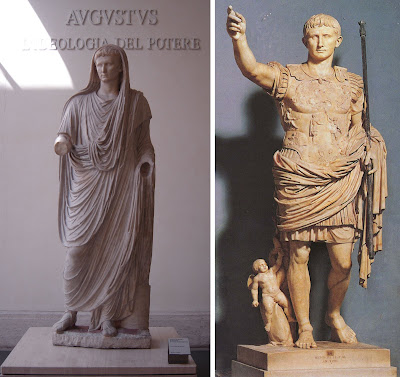 Left: Augustus, the Via Labicana portrait (c. 12 BC); found on slopes of Oppian Hill; National Museum of Rome.
Right: Augustus, the Prima Porta portrait (c. 20BC); found in Villa Livia at Prima Porta; Braccio Nuovo, Vatican Museums.
Responses to Rulers
 Portrait of Demosthenes, maybe by Polyeuktos, marble copy of Greek original (c. 280 BC); Glyptothek, Copenhagen.
 Portrait of Roman patrician with busts of ancestors, also known as the "Barberini Statue", (c. 30 BC); Capitoline Museum, Rome.
 Head of a bearded man, possibly Macrinus (c. 217-250 AD); Harvard Art Museum, Boston.
Precedents for Portraiture: Egypt
 Diorite statue of Chephren (Khafre) from the Valley Temple of Giza; (c. 2565 BC); Egyptian Museum, Cairo.
 Colossus of Akhenaten, found at Karnak, Temple of Aten (c. 1353 BC); Egyptian Museum, Cairo.
 Statue of Mentuemhet, Prince of Thebes; (c. 600 BC); Egyptian Museum, Cairo.
 Kouros from Attica, (c. 600-590 BC); Metropolitan Museum of Art, New York.
Precedents for Portraiture: Ancient Near East
 Gudea, ruler of Lagash in Southern Mesopotamia; seated diorite statue dedicated to the god Ningishzida (c. 2120 BC); excavated in Telloh (ancient Girsu, Iraq); Musee Louvre, Paris.
 Ashurbanipal, last ruler of Assyria,shown in a relief found at his palace in Nineveh (c. 668-624 BC); British Museum, London.
 Apollo and Artemis, Siphnian Treasury, N. Frieze Detail (c. 525 BC); Delphi Museum, Greece.
Archaic Greece
 Peplos Kore (c. 530 BC); Acropolis Museum, Athens.
 Kouros of Anavysos, third from the left (c. 540-530 BC); National Museum, Athens.
 Kore from outskirts of Athens, commemorating Phrasikleia by Aristion of Paros (c. 530 BC).
Zainab Bahrani, "Salmu: Representation in the Real" in The Graven Image: Representation in Babylonia and Assyria (Philadelphia 2003, 121-148.
Lawrence Berman, "The image of the king in Ancient Egypt" in Pharaohs: Treasures of Egyptian Art from the Louvre (Cleveland 1996), 23-29.
Mary Stieber, "The idea of likeness" in The poetics of appearance in the Attic korai (Austin 2004), 83-113.
I M A G E S
 Portrait-herm-bust of Themistocles. Found in the Caseggiato del Temistocle (V, XI, 2). Museo Ostiense. Second century AD? (original c. 470 BC)
 Tyrannicides, Roman copy of Greek original (c. 480 BC) by Kritios and Nesiotes.
 Left: Portrait bust of Homer (c.850-800 BC) copy after a Greek Hellenistic original; Museo Archeologico Nazionale, Naples.
Center: Head of Homer, Epimenides type. Roman copy after a Greek original from 5th century BC. Glyptothek, Munich.
Right: Portrait of Homer, known as Homer Caetani (the bust was found in the walls of the Caetani Palace at Rome). Pentelic marble, Roman copy (2nd century CE) of a Greek original (2nd century BC). Musee du Louvre, Paris.
 Roman bronze bust, the so-called Pseudo-Seneca, now generally identified as an imaginative portrait of Hesiod; Museo Archeologico Nazionale, Naples.
Ruler Portraits
 The victorious Alexander the Great in the Battle of Issus against Persian King Darius in 333 B.C. (Roman mosaic found in the House of the Faun, Pompeii, Italy.)
 Left: Augustus, the Via Labicana portrait (c. 12 BC); found on slopes of Oppian Hill; National Museum of Rome.
Right: Augustus, the Prima Porta portrait (c. 20BC); found in Villa Livia at Prima Porta; Braccio Nuovo, Vatican Museums.
Responses to Rulers
 Portrait of Demosthenes, maybe by Polyeuktos, marble copy of Greek original (c. 280 BC); Glyptothek, Copenhagen.
 Portrait of Roman patrician with busts of ancestors, also known as the "Barberini Statue", (c. 30 BC); Capitoline Museum, Rome.
 Head of a bearded man, possibly Macrinus (c. 217-250 AD); Harvard Art Museum, Boston.
Precedents for Portraiture: Egypt
 Diorite statue of Chephren (Khafre) from the Valley Temple of Giza; (c. 2565 BC); Egyptian Museum, Cairo.
 Colossus of Akhenaten, found at Karnak, Temple of Aten (c. 1353 BC); Egyptian Museum, Cairo.
 Statue of Mentuemhet, Prince of Thebes; (c. 600 BC); Egyptian Museum, Cairo.
 Kouros from Attica, (c. 600-590 BC); Metropolitan Museum of Art, New York.
Precedents for Portraiture: Ancient Near East
 Gudea, ruler of Lagash in Southern Mesopotamia; seated diorite statue dedicated to the god Ningishzida (c. 2120 BC); excavated in Telloh (ancient Girsu, Iraq); Musee Louvre, Paris.
 Ashurbanipal, last ruler of Assyria,shown in a relief found at his palace in Nineveh (c. 668-624 BC); British Museum, London.
 Apollo and Artemis, Siphnian Treasury, N. Frieze Detail (c. 525 BC); Delphi Museum, Greece.
Archaic Greece
 Peplos Kore (c. 530 BC); Acropolis Museum, Athens.
 Kouros of Anavysos, third from the left (c. 540-530 BC); National Museum, Athens.
 Kore from outskirts of Athens, commemorating Phrasikleia by Aristion of Paros (c. 530 BC).
Week 1: Syllabus & Rules
S Y L L A B U S
Topics in Ancient Art and Architecture: Ancient Portraiture
This course analyzes the development of portraiture from Classical Greece through the later Roman Empire. It draws on recent scholarship to call into question the traditional definition of portraiture as "descriptive likeness" and aims to present a broader and more nuanced view of the ancient portrait as a genre.
The course will consider both canonical monuments such as the Primaporta Augustus and less familiar works such as painted mummies from Roman Egypt and the imaginary portraits of poets and philosophers of the Hellenistic era. In addition, we will make use of the Metropolitan Museum's newly-installed Greco-Roman galleries, among the best collections of ancient portraits in America. Major topics will include the royal image, class and gender representation, the categories of center and periphery as applied to portraiture, and the mutilation and destruction of images.
Course Requirements
R U L E S
Each weekly post in this blog will contain:
Topics in Ancient Art and Architecture: Ancient Portraiture
This course analyzes the development of portraiture from Classical Greece through the later Roman Empire. It draws on recent scholarship to call into question the traditional definition of portraiture as "descriptive likeness" and aims to present a broader and more nuanced view of the ancient portrait as a genre.
The course will consider both canonical monuments such as the Primaporta Augustus and less familiar works such as painted mummies from Roman Egypt and the imaginary portraits of poets and philosophers of the Hellenistic era. In addition, we will make use of the Metropolitan Museum's newly-installed Greco-Roman galleries, among the best collections of ancient portraits in America. Major topics will include the royal image, class and gender representation, the categories of center and periphery as applied to portraiture, and the mutilation and destruction of images.
Course Requirements
- Class Participation, including regular attendance, completion of assigned readings, and one museum visit with instructon (9/13).
- One short (250-word) paper abstract.
- One fifteen-minute presentation on paper topic.
- One 10-12-page research paper (see term paper handout for details)
- One final (short answers and essay)
- Abstract (10%); due in class 9/30
- Presentation (15%); date TBA
- Paper (35%); due in class 12/2. Late papers will be penalized.
- Final exam (30%)
- Class participation, including attendance, museum visit, discussion (10%)
R U L E S
Each weekly post in this blog will contain:
- The assigned texts for that week, as noted on the syllabus;
- A brief, point-by-point summary of each reading;
- Relevant images, either scanned from the assigned texts or from another source;
- Any in-class notes taken when the texts are discussed.
Subscribe to:
Posts (Atom)